
Exporting aluminum profiles, aluminum windows, doors, and curtain wall components to Saudi Arabia requires more than preparing commercial invoices and shipping documents. Importers must determine whether their products fall under applicable Saudi technical regulations and whether conformity documentation is required through the SABER platform.
For aluminum manufacturers and exporters, the compliance route depends on the product’s intended use, technical characteristics, applicable regulations, and HS Code. Raw aluminum profiles, fabricated aluminum components, and finished aluminum windows or doors may follow different conformity assessment requirements.
This guide explains how SABER compliance works for aluminum products, what documentation exporters should prepare, and how manufacturers can reduce certification delays before shipment.
Last updated: November 2026
1. What Is SABER?
SABER is Saudi Arabia’s electronic conformity assessment platform used for products entering the Saudi market. It operates under the Saudi Standards, Metrology and Quality Organization (SASO) framework and supports the registration and conformity certification of regulated and non-regulated products.
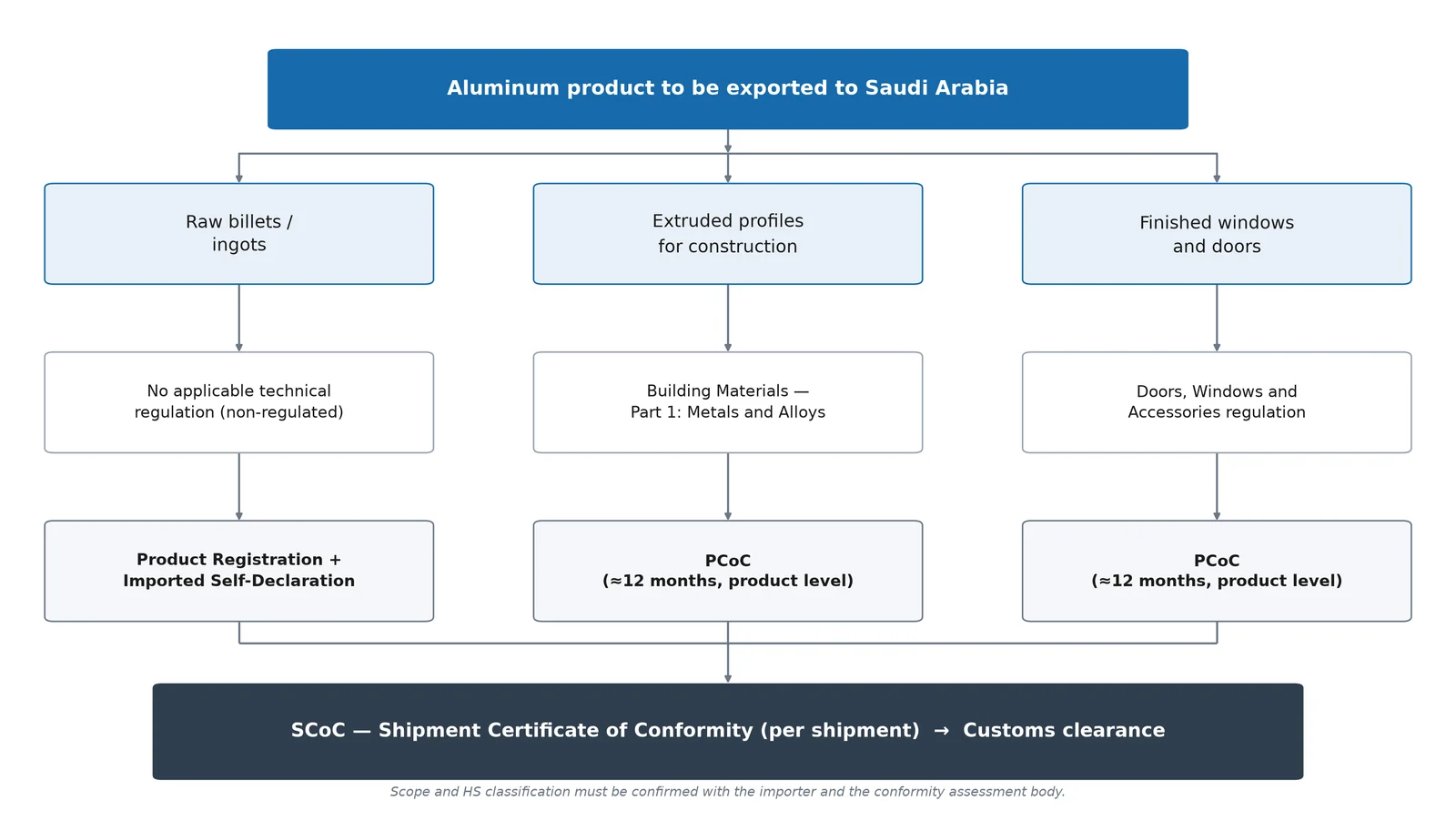
For applicable regulated products, the certification process generally involves a Product Certificate of Conformity (PCoC) and a Shipment Certificate of Conformity (SCoC). Non-regulated products may follow a different route, including product registration and an Imported Self-Declaration.
Exporters and importers can verify product requirements through the
official SABER platform.
SABER registration does not automatically mean that every product requires the same certificate. The applicable technical regulation and product classification must be confirmed before starting the certification process.
2. Which Saudi Technical Regulations May Apply to Aluminum Products?
Aluminum products can fall under different Saudi technical regulations depending on their classification and application. Two regulations that exporters should pay particular attention to are the regulations covering building materials and doors, windows, and their accessories.
2.1 Building Materials – Part 1: Metals and Alloys
The Saudi technical regulation for Building Materials – Part 1 covers specified metal and alloy products. Aluminum products under relevant HS Code categories may fall within its scope, depending on the exact classification and product characteristics.
Products potentially requiring assessment include:
- Aluminum extrusion profiles
- Aluminum bars and rods
- Aluminum tubes and hollow profiles
- Aluminum sheets and plates
- Structural aluminum components
- Specified aluminum construction products
The relevant official regulation is available here:
SASO Building Materials – Part 1: Metals and Alloys.
However, the fact that a product is made from aluminum does not automatically mean that it is covered by this regulation. Product classification and the applicable HS Code must be checked against the current SABER requirements.
2.2 Doors, Windows and Accessories
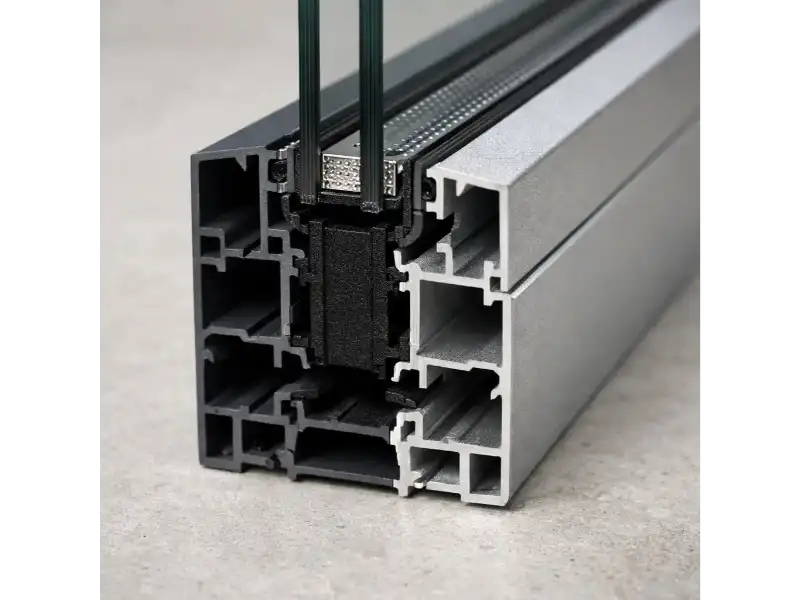
Finished aluminum doors and windows may be subject to a separate technical regulation covering doors, windows, and their accessories.
This is particularly relevant to products such as:
- Aluminum sliding windows
- Aluminum casement windows
- Aluminum entrance doors
- Aluminum sliding doors
- Aluminum bifold doors
- Aluminum window and door systems
- Related accessories covered by the regulation
If you are sourcing profiles rather than finished units, see our aluminum window and door profiles.
The official regulation can be reviewed here:
SASO Technical Regulation for Doors, Windows and Accessories.
This regulation distinguishes between different product categories and conformity assessment procedures. Fire-resistant doors and windows may have additional assessment requirements compared with ordinary doors and windows.
Exporters should therefore avoid treating finished aluminum windows and doors as equivalent to aluminum extrusion profiles. Their compliance requirements may be different.
3. How to Determine the Correct HS Code
HS Code classification is one of the most important steps in the SABER compliance process. The applicable technical regulation, conformity assessment route, and certificate requirements may depend on the product’s HS Code.
Aluminum products may fall under different HS Code headings depending on their material form, manufacturing process, geometry, and intended application.
| Product Category | Potential HS Code Heading | Classification Considerations |
|---|---|---|
| Aluminum bars and profiles | 7604 | Solid or hollow profiles, alloy and non-alloy classification |
| Aluminum tubes and pipes | 7608 | Tube or pipe classification based on product characteristics |
| Aluminum sheets and plates | 7606 | Thickness, alloy and product form |
| Aluminum structures and structural components | 7610 | Fabricated structures and parts of structures |
The codes shown above are general HS Code headings for reference. They should not be treated as final Saudi 12-digit tariff classifications.
Before certification, importers should verify the actual classification through the
SABER HS Code Search
and confirm the requirements for the specific product.
A product’s shape, processing level, intended use, and technical specifications may affect classification. For example, a raw aluminum extrusion profile and a fabricated structural component may not follow the same classification route.
4. Regulated and Non-Regulated Products
SABER distinguishes between regulated and non-regulated products. This distinction determines the documentation and conformity assessment route required for import.
Regulated Products
Products covered by an applicable Saudi technical regulation generally require conformity assessment according to the relevant regulation and product category.
Depending on the applicable requirements, the process may involve:
- Product registration on SABER
- Application for a Product Certificate of Conformity (PCoC)
- Technical documentation review
- Testing or evaluation by an approved conformity assessment body, where required
- Shipment Certificate of Conformity (SCoC) for the imported shipment
Non-Regulated Products
Products that are not covered by an applicable technical regulation may still require registration and import documentation through SABER.
Depending on the applicable route, the importer may need to complete:
- Product Registration
- Imported Self-Declaration
- Shipment Certificate of Conformity (SCoC)
The official requirements can be reviewed on the
SABER Non-Regulated Products page.
Non-regulated status should not be interpreted as an exemption from all import requirements. Importers must still verify the applicable customs classification, declaration requirements, and shipment documentation.
5. PCoC, SCoC and Self-Declaration Explained
Three documents are commonly discussed during the SABER certification process: Product Certificate of Conformity (PCoC), Shipment Certificate of Conformity (SCoC), and Self-Declaration.
| Document | Purpose | Typical Application |
|---|---|---|
| PCoC | Confirms product conformity with applicable requirements | Applicable regulated products |
| SCoC | Confirms conformity documentation for a specific shipment | Imported shipments requiring an SCoC |
| Self-Declaration | Declaration of compliance with applicable requirements | Products following an eligible self-declaration route |
5.1 Product Certificate of Conformity (PCoC)
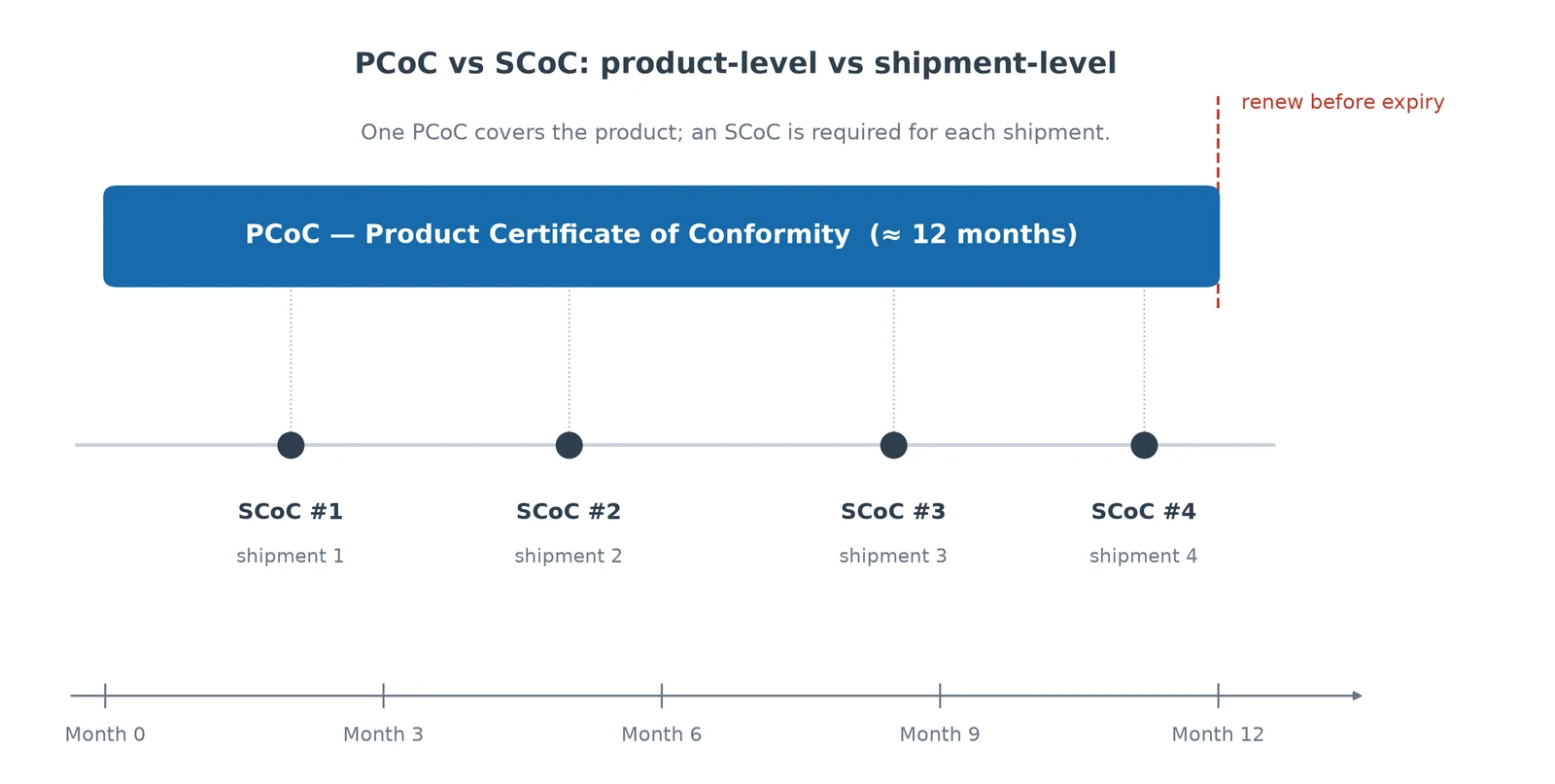
A PCoC is issued for products subject to the relevant conformity assessment requirements. It is generally associated with a product or product model rather than a single shipment.
Depending on the regulation, supporting documentation may include test reports, technical specifications, product photographs, manufacturer information, and other evidence required by the conformity assessment body.
A PCoC does not replace the shipment-level certificate when an SCoC is required.
Official service information:
SABER Product Certificate of Conformity service.
5.2 Shipment Certificate of Conformity (SCoC)
The SCoC is associated with a specific imported shipment. It is generally required before shipment clearance for products subject to the applicable SABER conformity route.
The importer usually needs to provide shipment-related information, including the commercial invoice, product details, and applicable conformity documentation.
Official service information:
SABER Shipment Certificate of Conformity service.
5.3 Self-Declaration
For products eligible for a self-declaration route, the importer may be required to submit a declaration confirming that the product complies with the applicable requirements.
Self-Declaration should not be assumed to apply to every aluminum product. Eligibility must be confirmed through the current SABER classification and regulatory requirements.
6. SABER Certification Process for Aluminum Exporters
For manufacturers exporting aluminum profiles, windows, doors, or fabricated aluminum components to Saudi Arabia, the following process provides a practical starting point.
- Confirm the product classification.
Identify the applicable Saudi HS Code based on the product’s material, geometry, manufacturing process, and intended use. - Check the applicable technical regulation.
Determine whether the product falls under Building Materials Part 1, Doors and Windows, another technical regulation, or a non-regulated route. - Confirm the conformity assessment route.
Identify whether PCoC, Self-Declaration, testing, or another assessment procedure is required. - Prepare technical documentation.
Collect specifications, drawings, test reports, material information, manufacturing details, and other required documents. - Register the product on SABER.
Complete product registration using the importer account and the appropriate product classification. - Obtain the required product conformity documentation.
Submit the application through the applicable route and complete the required assessment. - Apply for the shipment certificate.
Complete the SCoC application using the relevant shipment and invoice information before shipping or customs clearance, as applicable. - Verify the final documentation.
Ensure that product descriptions, HS Codes, quantities, invoices, certificates, and shipment details are consistent.
The exact sequence may vary depending on the product category and the importer’s requirements.
7. Technical Documents Aluminum Manufacturers Should Prepare
For aluminum profiles and fabricated aluminum products, a complete technical file can help reduce application delays and repeated document requests.
7.1 Aluminum Extrusion Profiles
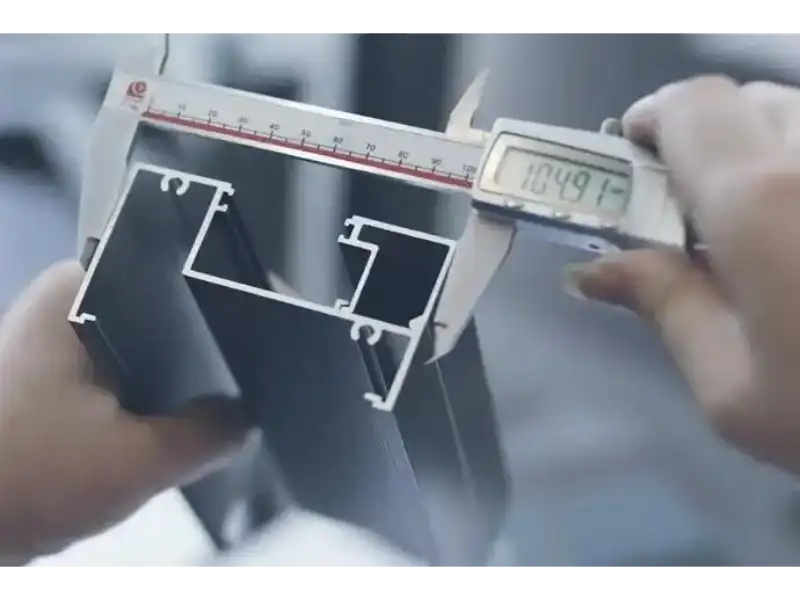
For custom aluminum extrusion profiles, the technical documentation may include:
- Product drawings and cross-sectional dimensions
- Aluminum alloy and temper specifications
- Material composition or relevant material certificates
- Mechanical properties, where applicable
- Dimensional tolerances
- Surface treatment specifications
- Product photographs
- Packaging and labeling information
- Relevant test reports
For example, profiles manufactured from 6063-T5 aluminum may be supported by material documentation and technical specifications demonstrating the required alloy, temper, mechanical properties, and dimensions.
For residential projects, the same documentation principles apply to our thermal break window profiles.
7.2 Aluminum Windows and Doors
Finished aluminum windows and doors may require additional documentation depending on the applicable technical regulation and product performance requirements.
- System drawings and installation details
- Profile specifications and alloy information
- Glass specifications
- Thermal performance documentation, where applicable
- Air permeability test reports
- Water penetration test reports
- Wind load resistance test reports
- Hardware and accessory specifications
- Fire performance documentation, where applicable
These documents are not universally mandatory for every aluminum window or door. The required evidence depends on the applicable regulation, product classification, assessment route, and performance claims.
For projects in the UAE, see our thermal break aluminum window and door systems.
8. SABER and Saudi Building Code: What Is the Difference?
SABER and the Saudi Building Code serve different purposes.
SABER is primarily related to product conformity assessment, registration, and import certification.
Saudi Building Code (SBC) provides requirements for building design, construction, safety, structural performance, and other building-related matters.
For aluminum building products, relevant building code requirements may relate to structural loads, energy efficiency, building envelope performance, and project-specific design requirements.
For example:
- SBC 301: Loads and forces, including structural design considerations.
- SBC 601: Energy conservation requirements for non-residential buildings.
- SBC 602: Energy conservation requirements for residential buildings.
The official
Saudi Building Code 2024
should be reviewed when aluminum products are specified for a building project.
Passing a SABER conformity assessment does not automatically mean that an aluminum window, door, curtain wall, or structural component meets every project-specific building code requirement.
For a specification-level comparison, read our guide to GCC aluminum window and door system specification.
9. Recent Regulatory Updates and Compliance Considerations
Saudi product conformity and customs requirements may change as regulations, HS Code classifications, and platform procedures are updated.
Exporters and importers should pay attention to the following issues:
9.1 HS Code Classification Updates
Saudi Arabia uses detailed tariff classifications. Importers should verify the current applicable 12-digit HS Code instead of relying solely on older tariff codes, historical certificates, or commercial descriptions.
A change in HS Code classification does not necessarily mean that every existing certificate becomes automatically invalid. The impact should be confirmed with the importer and the relevant conformity assessment body.
9.2 Product Declaration Requirements
Additional product declaration requirements may apply to selected products and HS Code categories under current Saudi import procedures.
These requirements are not universal across all aluminum profiles, windows, doors, or building materials. Importers should verify whether the specific product is affected before preparing additional declarations.
9.3 Product Marking Requirements
Saudi Arabia has introduced additional marking requirements for products covered by specified technical regulations. Requirements may include supplier, importer, or local manufacturer identification information.
The scope is regulation-specific. Aluminum exporters should check whether their products are included in the applicable technical regulation and whether the marking requirements apply to their particular product category.
Do not assume that every aluminum product is subject to the same new marking requirements.
10. Common SABER Compliance Mistakes
The following issues can lead to delays, additional costs, or shipment documentation problems.
- Using an incorrect HS Code: Product classification is not confirmed before certification.
- Assuming all aluminum products follow the same route: Raw profiles, fabricated components, and finished windows or doors may have different requirements.
- Submitting incomplete technical documentation: Drawings, specifications, material information, or test reports may be missing.
- Inconsistent product descriptions: The product description on the invoice does not match the registration or conformity documents.
- Starting certification too late: Product assessment and document preparation are left until the shipment is ready.
- Assuming PCoC replaces SCoC: Product certification and shipment certification serve different purposes.
- Ignoring importer coordination: The exporter and Saudi importer do not confirm the classification, certificate route, and shipment requirements before production or dispatch.
- Using outdated certificates or classification information: Current requirements are not checked before a new shipment.
11. SABER Certification Fees and Processing Time
SABER platform fees are separate from third-party testing, inspection, or conformity assessment service fees. Actual costs and processing times may depend on the product category, assessment route, and application completeness.
| Service | Platform Fee | Notes |
|---|---|---|
| Product Registration | Free | Registration service |
| Product Certificate of Conformity (PCoC) | SAR 500 | Excluding VAT; third-party assessment costs may be additional |
| Shipment Certificate of Conformity (SCoC) | SAR 350 | Excluding VAT; applicable per shipment |
| Imported Self-Declaration | Free | Subject to product eligibility and current requirements |
The fees shown are platform fee references and should be verified against the current SABER service pages before submitting an application.
Additional expenses may include:
- Laboratory testing
- Third-party conformity assessment services
- Sample preparation and transportation
- Technical document preparation
- Inspection services, where required
For exporters, the most effective way to reduce unnecessary certification costs is to confirm the product classification and conformity assessment route before submitting an application.
12. Practical Checklist Before Exporting Aluminum Products to Saudi Arabia
Before arranging shipment, exporters and importers should confirm the following:
- Product description and intended application are clearly defined.
- Applicable Saudi HS Code has been confirmed.
- Applicable technical regulation has been identified.
- Regulated or non-regulated status has been verified.
- Required PCoC or Self-Declaration route has been confirmed.
- Product registration has been completed, where required.
- Technical documentation is complete.
- Required testing or assessment has been completed.
- Shipment information and commercial invoice are accurate.
- SCoC requirements have been confirmed.
- Product marking and labeling requirements have been checked.
- Importer and exporter have confirmed the shipment documentation.
If you are still shortlisting suppliers, our list of Saudi aluminum window manufacturers covers the main local players and how to evaluate them.
13. Frequently Asked Questions
Do aluminum extrusion profiles require SABER certification?
Some aluminum extrusion profiles may be subject to applicable Saudi technical regulations and conformity assessment requirements. Others may follow a non-regulated route. The exact requirement depends on the product classification and current SABER HS Code information.
Do aluminum windows and doors require a separate SABER certificate?
Finished aluminum windows and doors may fall under the Saudi technical regulation for Doors, Windows and Accessories. Their conformity assessment requirements may differ from those of raw aluminum extrusion profiles. The applicable classification and assessment route should be verified.
Is a PCoC required for every aluminum product?
No. A PCoC is required for products following an applicable regulated conformity assessment route. Products eligible for other routes may require Self-Declaration or other documentation instead.
Can aluminum products be imported without a PCoC?
Some products may be eligible for a non-regulated or self-declaration route. However, importers must still confirm product registration, shipment certification, customs classification, and any other applicable requirements.
Does SABER certification guarantee that aluminum products comply with the Saudi Building Code?
No. SABER conformity assessment and Saudi Building Code compliance are different. Project-specific structural, energy efficiency, safety, and performance requirements may need to be evaluated separately.
Who is responsible for SABER certification, the exporter or the importer?
The Saudi importer generally manages the SABER application through its platform account. However, the exporter or manufacturer must provide accurate product information, technical documents, test reports, and supporting data required for the application.
Can the same SABER certificate be used for multiple shipments?
A Product Certificate of Conformity may cover an eligible product or product model according to its validity and scope. The Shipment Certificate of Conformity is associated with a specific shipment and must be obtained when required.
Preparing Aluminum Products for the Saudi Market?
Whether you are sourcing aluminum extrusion profiles, customized aluminum windows and doors, curtain wall components, or fabricated aluminum parts, confirming the product classification and technical documentation at an early stage can help reduce certification delays and shipment risks.
Our team supports aluminum product manufacturing, customized extrusion solutions, fabrication, and export requirements for international projects.
You can also review our aluminum profile catalog before sending drawings.
Contact us to discuss your aluminum product specifications and export requirements.
Official References
The following official sources can be used to verify the relevant requirements:
SABER Official Platform
SABER HS Code Search
SABER Non-Regulated Products
SABER Product Registration
SABER Product Certificate of Conformity
SABER Shipment Certificate of Conformity
SASO Building Materials – Part 1: Metals and Alloys
SASO Doors, Windows and Accessories Technical Regulation
Saudi Building Code 2024
Disclaimer: This article is provided for general informational purposes only and does not constitute legal, regulatory, or certification advice. Saudi technical regulations, HS Code classifications, certification procedures, and platform requirements may change. Importers and exporters should verify the latest applicable requirements with the official SABER platform, SASO, the relevant conformity assessment body, and the Saudi importer before shipment.