
Are You Buying the Wrong Aluminum Window and Door System for the Gulf?
A Riyadh villa project faced a rework bill nobody budgeted for. Not a structural failure. The procurement team picked standard aluminum window and door systems without thermal breaks to save a few dollars per square meter. During Jun handover, west-facing interior temperatures ran 3–5°C hotter than the corridor. HVAC hit 100% capacity and couldn’t close the gap.
That’s a specification problem. It showed up after the building was finished.
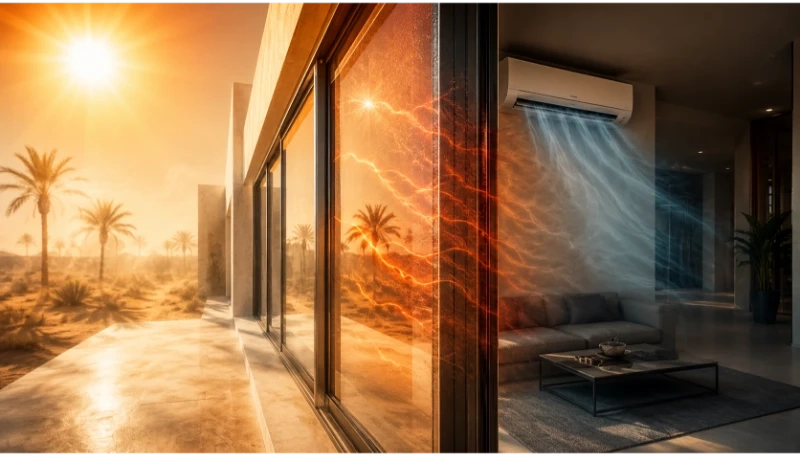
Visually demonstrates the outstanding thermal insulation performance of high-end aluminum window and door systems in extreme high-temperature environments, such as the Gulf region’s desert climate. By visualizing the thermal break effect, it highlights the core role of insulated profiles and energy-efficient glass in maintaining constant indoor temperatures and reducing AC energy consumption. Ideal for green building and energy-saving building material promotions.
Which System Fits Your Project?
| Window & Door Type | Best For | Main Advantage | Main Risk |
|---|---|---|---|
| Sliding | Apartments & Hotels | Space saving | Sand infiltration |
| Casement | Villas & Offices | Air tightness | Higher cost |
| Awning | Kitchens & Utility Areas | Controlled ventilation | Limited opening |
| Fixed | Curtain Walls | Maximum performance | No ventilation |
| Bifold | Luxury Villas | Full opening | Thermal expansion |
| Lift & Slide | Premium Projects | Insulation & durability | Initial cost |
The table looks simple. Choosing wrong isn’t.
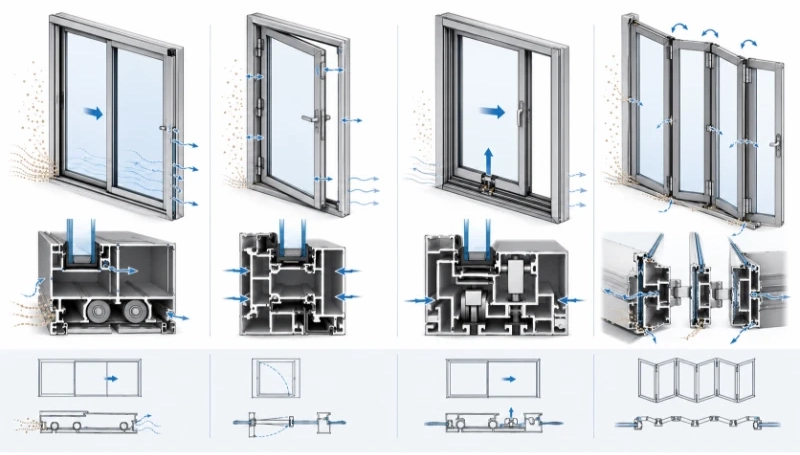
An ultra-clear technical diagram designed for construction projects in the Gulf region. Featuring a clean blueprint style with a blue-gray color palette, it deeply analyzes the structural behavior of four aluminum window and door systems: sliding (visible gaps), casement (multi-point compression sealing), lift and slide (lifting/locking mechanism), and bifold (multiple joints and thermal expansion stress points). An ideal illustration for technical documentation, B2B building product selection, and engineering manuals.
Why Do Sliding Systems Fail Before Buyers Expect?
Sliding systems dominate mid-tier apartments and hotels across the Gulf. They save space, cost less, and look fine on a spec sheet.
They also jam.
In Riyadh, airborne dust settles into tracks, grinds down rollers, and kills seals within two sandstorm seasons. A system that holds up in Muscat struggles badly in Riyadh — dust exposure isn’t comparable. In Dubai and Jeddah, salt air corrodes hardware from inside the frame. Higher maintenance frequency, deteriorating air tightness, shortened hardware lifespan.
If budget forces a sliding aluminum window and door system, specify multi-chamber dust-proof tracks, stainless steel hardware, and high-density EPDM seals. Skip those, and maintenance costs erase the procurement savings before year two.
Why Do Casement Systems Outperform Everything Else on Air Tightness?
Casements seal mechanically. That’s the whole reason architects default to them for luxury villas in Riyadh and Abu Dhabi.
A multi-point lock compresses the sash hard against EPDM gaskets around the full perimeter. A sliding system can’t do that — the panels move laterally, so there’s always a gap in the sealing logic. At 50°C outdoor temperatures, that gap is expensive.
PA66 GF25 is the thermal break material that holds up under sustained Gulf heat.
Is Lift & Slide Actually Worth the Cost?
A standard sliding door loads its rollers continuously. Large panels weigh 150kg or more. In coastal environments like Dubai Marina or Doha waterfront developments, that sustained load deforms profiles and crushes seals.
Lift & slide solves this differently. Rotate the handle and the panel lifts off its seals before sliding. Lock it closed and it drops back down, compressing the gaskets uniformly.
It costs more — but it prevents long-term failure.
What Actually Destroys Bifold Doors in Gulf Heat?
Aluminum expands. That’s physics, not a defect.
A 6-meter bifold door in direct Gulf sunlight moves continuously throughout the day. Cheap hinges cannot absorb that movement — panels drift, alignment fails, the door stops closing properly.
Minimum 2.0mm wall thickness and 50,000+ cycle hardware are baseline requirements.
Why Do Fixed Windows Outperform Every Other System?
No moving parts. No failure points. Fixed windows carry wind loads in Dubai, Doha, and Jeddah without maintenance cycles for decades.
Awning systems handle controlled ventilation in kitchens and utility rooms.
Does Your City Change the Specification?
Yes. Significantly.
Riyadh is heat and dust. Jeddah is salt corrosion. Dubai is heat plus humidity. Doha adds condensation risk. Muscat is coastal degradation.
One specification does not fit all Gulf climates.
What Do the Numbers Tell You?
| Performance Item | Range |
|---|---|
| Wall Thickness | 1.8–2.0mm |
| Thermal Break Width | 24–34mm |
| Air Tightness | Class 4 |
| Wind Resistance | 2400–5000Pa |
| Surface Finish | Powder coating / AA25 |
Where Do Procurement Decisions Go Wrong?
Thickness is not performance.
Thermal break material matters more than profile weight.
Hardware failure is the most expensive mistake in the system.
Which System Should You Actually Specify?
| Project Type | Recommended System |
|---|---|
| Villa | Casement + Lift & Slide |
| Apartment | Sliding + Thermal Break |
| Hotel | Sliding + Fixed |
| Office | Curtain Wall + Casement |
| Coastal | Thermal Break + AA25 |
If a building operates under continuous cooling for 20–30 years, system selection is not a procurement decision — it is an energy strategy decision.
The cheapest aluminum window and door system is usually the most expensive one over its lifecycle.
Frequently Asked Questions (Aluminum Window and Door Systems in the Gulf)
How long do aluminum window and door systems last in Saudi Arabia?
Properly specified systems typically last 20–30 years in Saudi Arabia. The aluminum frame itself is stable, but hardware and seals usually require maintenance or replacement after 8–12 years in high dust and high temperature environments like Riyadh and Dammam.
Are thermal break aluminum window and door systems worth the cost?
Yes, especially for air-conditioned buildings in the Gulf. Thermal break systems significantly reduce heat transfer through the frame, which directly lowers HVAC load. In high-glazing projects, the lifecycle energy savings often exceed the initial cost difference.
Which aluminum window and door system is best for desert climates?
Casement systems with thermal breaks generally perform best in desert environments. They provide higher air tightness compared to sliding systems and better dust resistance under sandstorm conditions common in Riyadh, Doha, and Abu Dhabi.
What is the difference between sliding and casement aluminum systems?
Sliding systems prioritize space-saving and cost efficiency but have weaker sealing performance. Casement systems use compression sealing through multi-point locking, making them more airtight and better suited for extreme climates like the Gulf region.
Do coastal projects require special aluminum finishes?
Yes. Coastal environments such as Dubai Marina, Jeddah, and Muscat require AA25 anodizing or marine-grade powder coating. Salt exposure accelerates corrosion, so surface treatment quality directly affects service life.