I. Why Is It Wrong to Say “Aluminum Doesn’t Rust”?
As Saudi Arabia once again issued an “Excessive Heat” alert this summer, the coastal regions of the Gulf Cooperation Council (GCC) are becoming the “ultimate testing ground” for aluminum corrosion in marine environments. When temperatures soar above 50°C, relative humidity along the coasts of the Red Sea and the Persian Gulf often exceeds 90%, and the concentration of salt fog in the air is several times higher than in typical marine environments. Under this triple assault of “high temperature, high humidity, and high salt fog,” the natural oxide film on the aluminum surface breaks down within weeks, producing a white, powdery corrosion product known as “How to prevent white rust on aluminum” —a critical concern for every coastal project.
In Saudi Arabia, as real estate regulations continue to tighten (such as the recent “Saudi Arabia vacant property fee” policy that sparked nationwide debate), developers and property owners are more focused than ever on preserving the long-term value of their assets. If the aluminum profiles on a building’s facade become covered with white rust within just two or three years, it will not only completely destroy its luxurious aesthetic appeal but also lead to deep structural corrosion, causing the property’s value to plummet. Therefore, for the wave of mega-projects currently sweeping Saudi Arabia, dispelling the misconception that “aluminum does not rust” is an absolute prerequisite for safeguarding the lifespan of buildings and the value of assets.
II. What Is White Rust? Why Does Aluminum “Rust”?
Many people mistakenly believe that aluminum’s natural oxide layer, combined with protective coatings or anodization, makes it immune to corrosion. This is actually a common misconception. Aluminum alloys do rust; they simply rust differently than iron, and the resulting rust is white.
Iron rusting: Iron reacts with oxygen and water to form reddish-brown iron oxide. The rust layer is loose and porous, constantly flaking off and exposing the underlying iron until the entire piece is completely “rusted through.”
Aluminum rusting: A dense layer of aluminum oxide (Al₂O₃) naturally forms on the surface of aluminum. This film acts as a barrier against water and oxygen, preventing further reaction of the aluminum substrate. As a result, aluminum exhibits excellent corrosion resistance in normal environments. However, in humid, high-salt-fog coastal regions—especially under the extreme conditions of the GCC—the natural oxide film is penetrated by chloride induced pitting corrosion aluminum, causing electrochemical degradation of the aluminum substrate and the formation of white aluminum hydroxide [Al(OH)₃] powder—this is “white rust.”
The 3‑Step Evolution of White Rust on Aluminum
Step 1: Intact Defense Phase
In a mild environment, the natural oxide layer (2-10 nm) remains dense and intact. It perfectly isolates the air, protecting the underlying aluminum substrate from any corrosion.
Step 2: Cl⁻ Attack & High Humidity
Under extreme GCC climate conditions (RH > 80%), a highly conductive water film forms. High concentrations of chloride ions (Cl⁻) from sea spray penetrate this film, aggressively bombarding and dissolving the oxide layer.
Step 3: Pitting & White Rust Eruption
The defense is breached! Chloride ions contact the raw aluminum, triggering a violent electrochemical reaction. The resulting aluminum hydroxide (White Rust) expands in volume, erupting from within and completely destroying structural integrity.
III. Why is white rust much more severe in the GCC region than elsewhere?
The six countries of the Gulf Cooperation Council (GCC)—Saudi Arabia, the United Arab Emirates, Qatar, Kuwait, Bahrain, and Oman—experience a combination of extreme climatic conditions rarely found elsewhere in the world:
- High temperatures: Summers consistently exceed 50°C, with surface temperatures sometimes surpassing 70°C.
- High humidity: Coastal relative humidity remains above 80% year-round, with frequent nighttime dew formation.
- High salt fog: The salinity of the Persian Gulf can exceed 40‰, resulting in very high concentrations of chloride ions in the air.
- Intense UV radiation: The scorching desert sun causes organic coatings to chalk rapidly.
- Sandstorms: Strong winds carry sand particles that strike surfaces at high speeds, creating micro-scratches and forming conductive salt slurry.
The combined impact of these five factors causes the corrosion rate of aluminum profiles along the GCC coastline to be several times faster than in inland environments. This phenomenon is particularly pronounced in Saudi Arabia—as mega-projects such as NEOM and the Red Sea tourism initiative expand along the coastline, unprecedented demands are being placed on the best aluminum alloy for coastal areas. Recent events (Al-Hilal vs. NEOM) indicate that public and industry attention toward projects along the Red Sea coast is at an all-time high. The selection of aluminum materials for these projects must adhere to marine-grade protection standards; otherwise, they will face catastrophic premature failure.
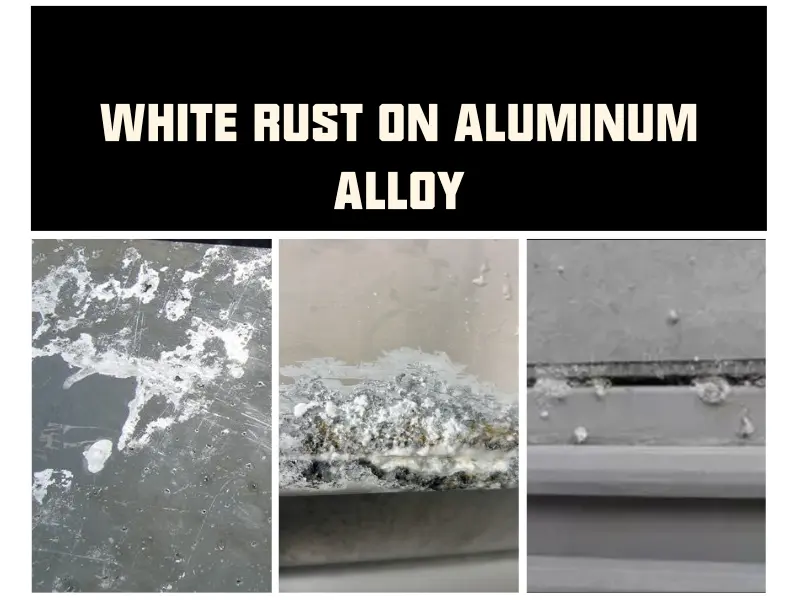
Different degrees of white rust formation on aluminum alloy surfaces. Left: Severe pitting corrosion with powdery Al(OH)₃ deposits; Middle: Edge corrosion at profile cut ends; Right: Joint corrosion at aluminum extrusion connections. All are typical failures caused by high temperature, high humidity and high chloride levels in GCC coastal regions.
IV. Four Major Causes of Aluminum Protection Film (Aluminum Oxide) Failure in the GCC Region
1. Chloride Ion Corrosion (The Primary Culprit)
The air in high-salt-fog areas of the GCC (such as the Persian Gulf and Red Sea coasts) is rich in chloride ions (Cl⁻). Chloride induced pitting corrosion aluminum occurs when these ions, having an extremely small radius and high charge density, displace oxygen atoms in aluminum oxide, disrupting the oxide film structure and forming easily hydrolyzable aluminum chloride (AlCl₃). This triggers galvanic reactions, accelerating pitting corrosion. Chloride ions preferentially attack weak points in the oxide film (scratches, grain boundaries); once the film is breached, corrosion becomes uncontrollable.
2. Corrosion by Acidic and Alkaline Substances
The oxide film is relatively stable in environments with a pH of 4–9. However, dust storms in the GCC region may carry acidic industrial pollutants (sulfates, nitrates), while alkaline materials used in construction—such as concrete and mortar (pH 10–13)—can dissolve the oxide film when in direct contact with aluminum profiles, causing extensive corrosion.
3. Damage to Coatings from Ultraviolet (UV) Radiation
Conventional powder coating is an organic coating. Under the intense UV radiation of the GCC, UV degradation of powder coated aluminum leads to polymer chain breakdown, causing the coating to chalk, fade, and crack, thereby losing its protective function. Therefore, for coastal projects in Saudi Arabia, marine grade aluminum anodizing thickness (AA25 or higher), Qualicoat seaside class 2 specifications, or PVDF coating must be used to withstand the dual assault of UV radiation and salt spray.
4. “Micro-scratches” from Sandstorms and Conductive Salt Paste
The sandstorms unique to the GCC region not only physically scratch the coating, exposing the aluminum substrate; when sand mixes with nighttime dew, it forms a high-concentration electrolyte salt paste in the gaps of the profiles. This triggers crevice corrosion in aluminum extrusions, an extremely dangerous oxygen-deficient concentration cell effect that can increase the local corrosion rate by tens of times.
V. How to Prevent White Rust on Aluminum Alloys in the GCC Region?
Based on the above analysis, we propose a comprehensive anti-white rust solution covering the entire chain from materials → surface treatment → design → transportation → maintenance, specifically targeting mega-projects in Saudi Arabia (such as NEOM and the Red Sea Project) and high-value commercial real estate.
5.1 Selecting Corrosion-Resistant Aluminum Alloy Substrates
Heavy salt fog zones (e.g., all of Bahrain, the northern coast of Qatar, the Abu Dhabi waterfront in the UAE, the coastal areas of Jeddah and Dammam in Saudi Arabia, Jubail Industrial City, and the Red Sea coast where NEOM is located):
Prioritize 5052 or 5083 (5xxx series). These alloys have high magnesium content and exhibit far superior pitting resistance compared to the 6xxx series, making them the best aluminum alloy for coastal areas.
Low-to-moderate salt fog zones (e.g., Riyadh, Saudi Arabia; inland areas more than 5 km from Doha, Qatar; and inland areas of Dubai, UAE):
Select high-quality primary aluminum 6063-T5/T6 with a copper content of ≤0.1%. The salt fog resistance of 6063 is approximately 60% higher than that of copper-containing 6061.
5.2 Surface Treatment — The “Line Between Life and Death” in GCC Environments
✅ Anodizing
Marine grade aluminum anodizing thickness is the first line of defense. The coating must meet AA25 (average thickness ≥25μm). AA25 is strongly recommended for the following regions/project types:
- Saudi Arabia: Entire NEOM region, Red Sea tourism projects, Jeddah Waterfront, areas surrounding the King Fahd Causeway in Dammam, Jubail Industrial City
- United Arab Emirates: Saadiyat Island in Abu Dhabi, Palm Islands in Dubai, Jebel Ali Port
- Qatar: Lusail City, Doha Waterfront
- Coastal projects throughout Bahrain, Kuwait, and Oman
Sealing quality is equally critical: strictly perform high-temperature pure water sealing or nickel salt sealing, and verify via admittance testing and staining tests. AA25 with poor sealing is also considered scrap.
✅ Powder Coating (Qualicoat Seaside Grade)
For projects requiring color and texture flexibility, you must specify Qualicoat seaside class 2 specifications (or Class 3, Seaside grade) and meet the following:
- Average film thickness ≥60μm
- Etching depth ≥2 g/m²
- Pass 1,000-hour neutral salt spray test and filiform corrosion test
For ultra-long-life requirements (e.g., NEOM landmark buildings), directly use PVDF coating for aluminum facade (AAMA 2605 standard), ensuring color and gloss retention for over 20 years.
5.3 Detailed Control Measures for Design, Transportation, and Maintenance
- Prevent direct contact between dissimilar metals: Insulating shims or nylon washers must be used between aluminum and stainless steel or galvanized steel. SS316 (Grade A4) stainless steel fasteners are recommended.
- Eliminate water accumulation: Drainage holes must be provided in horizontal sections of profiles to prevent water retention in joints, which can lead to crevice corrosion in aluminum extrusions.
- Moisture-proof transportation packaging: Preventing aluminum oxidation during shipping requires avoiding moisture-absorbing materials like paper or burlap. Use PE moisture-proof bags combined with shrink wrap for fully sealed packaging, and place sufficient desiccant inside the container.
- Regular cleaning and maintenance: For coastal projects, it is recommended to rinse with clean water monthly to remove salt deposits; immediately cover any coating damage with aluminum touch-up paint upon discovery.
VI. The Cost of Preventing White Rust on Aluminum Is Always Lower Than the Cost of Post-Repair
In the extreme coastal environments of the GCC, particularly against the backdrop of mega-projects such as Saudi Arabia’s NEOM and Red Sea initiatives currently underway, the issue of white rust is no longer an “optional” technical detail but a core factor determining the lifespan of buildings and the value of assets. Real-time search data indicates that public concern in Saudi Arabia regarding “extreme heat” is surging, and discussions surrounding the “vacancy fee” policy reflect property owners’ strong desire to preserve asset value. This is the optimal moment to convey the correct technical principles to the market.
How to prevent white rust on aluminum is not an added cost; it is an investment in protection. From selecting the best alloy for coastal areas, using adequate marine grade anodizing thickness, specifying Qualicoat seaside class 2, and preventing aluminum oxidation during shipping—every investment will pay off in the form of future maintenance-free years and high residual value recovery. For developers, contractors, and architects currently involved in or planning coastal projects in Saudi Arabia, the UAE, Qatar, and other countries, now is the time to re-evaluate aluminum corrosion protection standards.
Don’t let white rust become the first “scar” on your curtain wall.