
For buyers sourcing commercial aluminum roller shutters for projects in the Middle East, obtaining a quotation is rarely the hardest part. The real challenge is determining whether the proposed system will perform reliably under actual site conditions—and whether the specification is appropriate for the building, the operating schedule, and the local environment.
Consider a commercial property near the coast in Dubai. Its roller shutters are exposed to intense sunlight, humidity, and salt-laden air. If the surface finish and exposed hardware are not selected with these conditions in mind, deterioration may become apparent after installation. A warehouse in Riyadh faces a different set of challenges. Fine sand can accumulate inside the guide rails, while frequent opening and closing places repeated demands on the motor and moving components.
Neither problem is necessarily reflected in the original purchase price. The additional cost may only become apparent later, through maintenance, replacement parts, or operational downtime.
This is why buying commercial aluminum roller shutters involves more than comparing profile thicknesses, colors, and unit prices. Buyers need to understand where the shutters will be installed, how often they will operate, and whether the proposed configuration is suitable for the project.
This guide examines the practical considerations behind roller shutter selection for retail premises, warehouses, and industrial buildings in the Middle East, with a particular focus on technical specifications, supplier quotations, and international delivery.
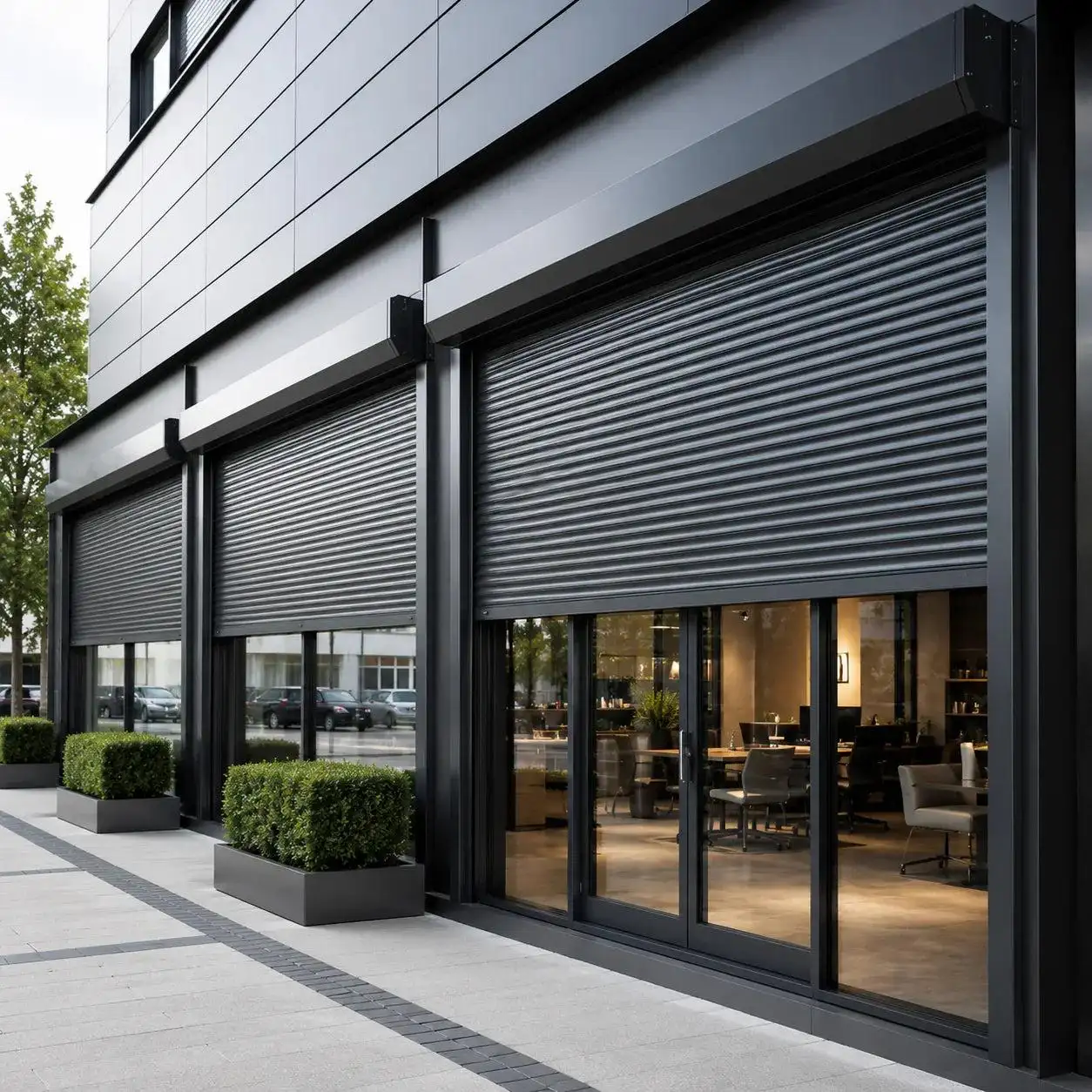
High-security aluminum roller shutters providing physical barriers for retail stores.
1. Dubai and Riyadh Have Different Requirements: Start with the Site Conditions
It is easy to describe the Middle East as a high-temperature market. However, treating every project as the same type of hot environment overlooks the factors that actually influence product selection.
A coastal commercial building and an inland warehouse may require different materials, protective finishes, guide-rail arrangements, and maintenance strategies.
1.1 Coastal Projects: Aluminum Alone Does Not Guarantee Corrosion Resistance
In coastal locations such as Dubai, Abu Dhabi, and Jeddah, humidity and airborne salts can accelerate the deterioration of exposed metal components.
Aluminum has a natural oxide layer that provides protection against atmospheric corrosion, making it suitable for many commercial applications. However, this does not mean that every aluminum roller shutter is automatically suitable for a marine environment.
A complete roller shutter system contains more than the curtain. Shafts, brackets, fasteners, bearings, and other hardware may also be exposed to moisture and salt. Even when the aluminum profiles remain in good condition, corrosion affecting other components can increase maintenance requirements and, in some cases, interfere with operation.
For projects near the coast, buyers should look beyond the general description of the aluminum material.
What should be checked before placing an order?
- Surface finish: Confirm whether the profiles are powder-coated or anodized, and request the relevant coating specifications.
- Exposed hardware: Check the material and protective finish of brackets, fasteners, and other metal components.
- Metal-to-metal contact: Determine whether the design addresses galvanic corrosion where dissimilar metals meet in the presence of moisture.
- Supporting documentation: Ask whether the supplier can provide coating data or relevant corrosion-test results for the proposed configuration.
These questions are more useful than simply asking whether a product is rust-resistant. Corrosion performance depends on the material, finish, component design, installation environment, and maintenance practices.
For highly exposed coastal installations, a suitable cleaning and inspection schedule is also important. Removing accumulated salt and surface contaminants can help preserve protective finishes, although maintenance cannot compensate for an unsuitable coating system.
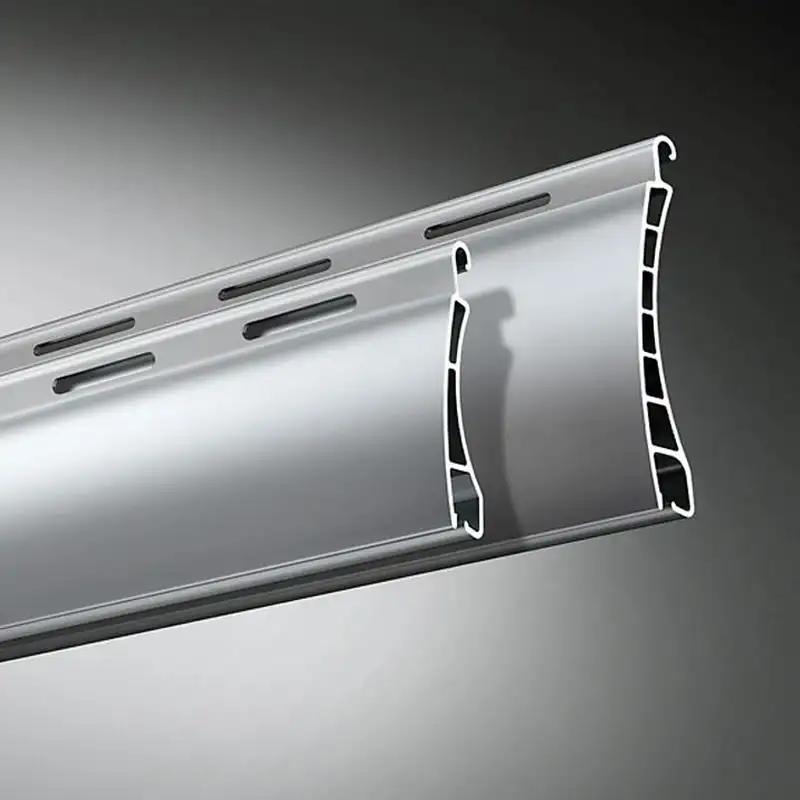
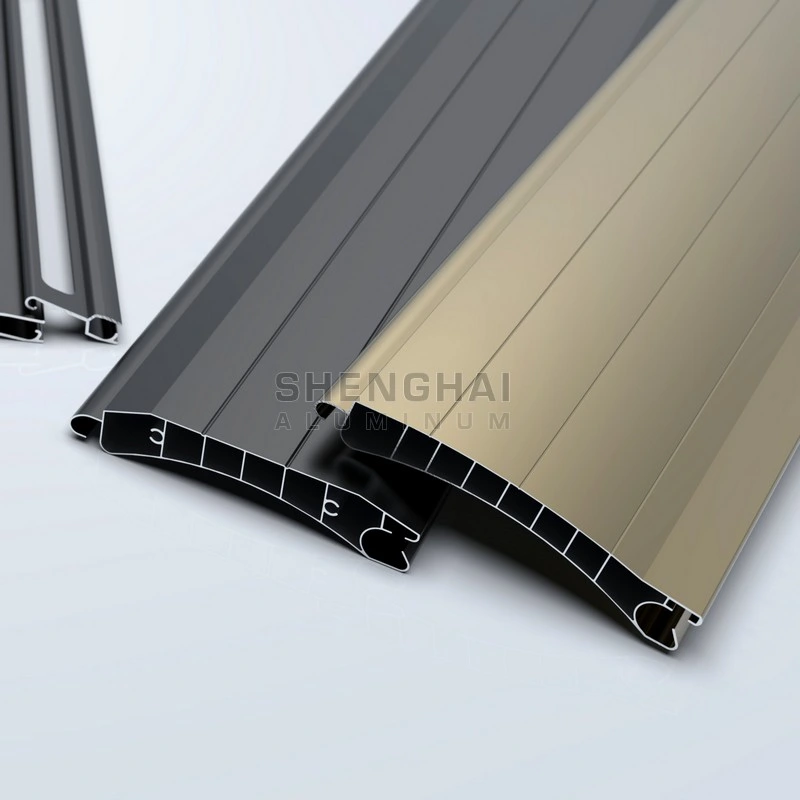
Double-walled aluminum profiles engineered for extreme Middle East climates and high wind loads.
1.2 Dust and Sand: Guide-Rail Design Matters More Than It First Appears
In areas affected by frequent sandstorms, operating problems do not always appear immediately after installation.
Fine particles can gradually accumulate inside the guide rails. Depending on the design, installation accuracy, and maintenance conditions, this buildup may increase friction, create operating noise, or accelerate wear on moving components.
The guide rails therefore deserve as much attention as the curtain profiles during procurement.
Dust brush seals can help reduce the amount of dust entering the guides, but they cannot prevent all sand ingress. The clearance between the curtain and the guide rails also needs to be appropriate for the selected profile and operating conditions.
If the clearance is excessive, curtain guidance and stability may be affected. If it is too tight, friction can increase, particularly when installation tolerances are poor or debris accumulates.
For projects in Riyadh and other dust-prone locations, buyers should ask suppliers to explain the guide-rail arrangement, sealing options, cleaning access, and maintenance requirements.
A general claim such as “dustproof design” is not enough to establish how the system will perform in a particular environment.
1.3 High Temperatures: A Motor That Can Lift the Curtain May Still Be the Wrong Choice
Motor selection is another area where an apparently competitive quotation can conceal important differences.
A roller shutter may operate normally during initial commissioning without being suitable for its intended long-term operating schedule. Curtain weight, shaft arrangement, transmission resistance, opening frequency, and ambient temperature all affect the demands placed on the drive system.
For retail entrances, parking facilities, and logistics buildings where shutters operate repeatedly throughout the day, motor selection should account for both load capacity and duty cycle.
Two different questions must be answered:
Can the motor lift the curtain?
And can it operate at the frequency required by the project without exceeding its specified operating limits?
Answering the second question requires checking rated torque, duty classification, permissible operating temperature, and thermal protection. For frequently operated shutters, buyers should also confirm the manufacturer’s specified operating cycle and the conditions under which the motor may need to cool before restarting.
If power interruptions are a concern, manual emergency operation should be discussed before the order is finalized. Its availability, operating method, and inclusion in the quotation should be clearly established.
The objective is not simply to select a more powerful motor. It is to match the motor, curtain weight, drive arrangement, and actual operating schedule.
2. Choosing the Right Curtain: Solid, Perforated, or Insulated?
Two aluminum roller shutters may look similar in a product photograph but perform very differently in service. Curtain construction affects visibility, ventilation, security, insulation, and the overall suitability of the door for a particular application.
The best choice depends on what the opening needs to achieve.
2.1 Solid Aluminum Roller Shutters for Retail and Commercial Premises
Solid aluminum roller shutters are commonly considered for shopfronts, commercial units, and other openings where privacy and physical separation are important.
They provide an opaque barrier when closed, making them suitable for premises that do not require visibility through the curtain outside business hours.
However, buyers should not assume that a solid curtain automatically provides a particular level of burglary resistance. Actual security performance depends on the complete system, including the profile design, locking arrangement, guide rails, fixing points, and installation.
For retail projects, it is worth confirming whether the standard locking arrangement meets the intended use or whether additional security features are required.
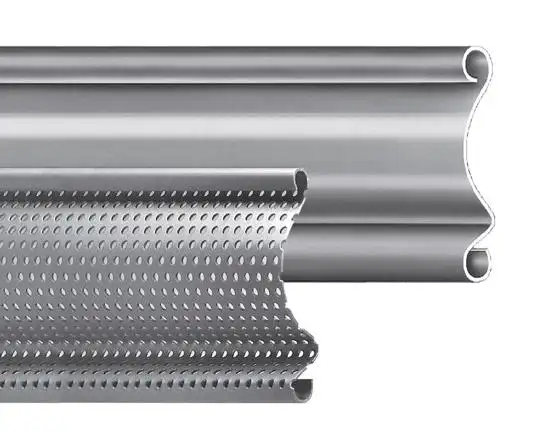
Close-up cross-section of double-walled extruded aluminum roller shutter slats showing curved surface and connection structure
2.2 Perforated Roller Shutters for Shopfront Visibility
Perforated aluminum roller shutters are often used where retailers want some visibility and ventilation while maintaining a physical barrier.
They can be suitable for shopping-center units, street-facing shops, and display areas where merchandise remains visible after closing.
The trade-off is that perforations change the curtain’s visual privacy, airflow, and light transmission. They also mean that the curtain should not be treated as an airtight or fully opaque barrier.
Before specifying a perforated system, buyers should confirm the opening dimensions, profile design, desired visibility, and required security level.
For projects with specific wind-load requirements, the suitability of the perforated curtain must also be evaluated as part of the complete shutter system.
2.3 Insulated Aluminum Roller Shutters for Temperature-Controlled Buildings
Where heat transfer through the opening is a concern, insulated aluminum profiles with a polyurethane foam core may be worth considering.
These profiles generally use two aluminum skins separated by an insulating core. The construction can reduce heat transfer through the curtain compared with an uninsulated profile, depending on the design and installation.
However, the insulation value of the profile alone does not determine the thermal performance of the complete opening. Air gaps, side guides, bottom seals, and installation details can all influence the result.
For an air-conditioned warehouse in the Middle East, an insulated curtain may contribute to reducing unwanted heat gain. For a cold room or temperature-critical facility, the requirements are more demanding.
In those cases, buyers should establish the required thermal performance, air leakage limits, temperature range, and operating conditions before selecting the door.
A standard insulated roller shutter should not automatically be treated as a replacement for a purpose-designed cold-room door.
3. Wind Resistance: Why Profile Thickness Is Only Part of the Answer
Wind resistance can be a critical specification for warehouses, factories, and commercial buildings with large external openings.
A closed roller shutter presents a surface to the wind. The resulting pressure is transferred through the curtain and guide rails to the brackets, fixings, and supporting building structure.
This load path is important because a strong curtain alone cannot compensate for an inadequate guide-rail arrangement or poorly designed fixing points.
3.1 Start with the Required Wind Load
The wind load applicable to a project depends on factors such as the building location, height, surrounding terrain, exposure, opening dimensions, and the relevant design standard.
For this reason, a supplier should not recommend a wind-resistance configuration based solely on a general description such as “high-wind area.”
The project specification should identify the applicable design requirements and, where relevant, the required classification under EN 12424.
Buyers should then ask the supplier to establish whether the proposed system has supporting classification or test documentation.
3.2 Check the Complete Assembly
When reviewing a quotation or technical drawing, examine the following elements together:
- Curtain profile geometry and reinforcement.
- Maximum permitted opening width and height.
- Guide-rail design and curtain engagement.
- Bottom-bar construction.
- Brackets, anchors, and fixing arrangements.
- Compatibility with the supporting wall or structural frame.
A thicker profile or reinforced guide rail may improve performance in a suitable design, but neither feature alone proves that the complete shutter meets a specified wind-load class.
If the project has demanding wind-load requirements, confirm the proposed configuration before production. Changing the guide rails, reinforcement, or fixing arrangement after the shutter has been manufactured can create avoidable costs and delays.
4. Installation Measurements: Small Errors Can Become Expensive Problems
For overseas projects, dimensional mistakes can be particularly costly because the door may already have been manufactured, packed, and shipped before the issue is discovered.
Three measurements deserve particular attention: opening size, headroom, and side room.
4.1 Opening Width and Height
The supplier needs to know whether the dimensions refer to the structural opening, the finished opening, or the required clear passage.
These are not always the same.
For example, if guide rails project into the opening, the clear passage may be narrower than the structural opening. The exact arrangement depends on the shutter design and installation method.
Before production, the buyer and supplier should agree on the reference points used for every measurement.
4.2 Headroom Above the Opening
Headroom is the available space above the opening for the curtain roll, shaft, brackets, and hood where applicable.
A restricted headroom condition may require a different mounting arrangement or a specially designed solution.
This should be resolved at the drawing stage rather than after delivery, when changing the installation layout may affect both cost and the available clear passage.
4.3 Side Room Beside the Opening
Side room is the available space beside the opening for guide rails, brackets, drive components, and any required safety equipment.
It is particularly important when the opening is close to a wall, column, neighboring door, or other building element.
For projects involving multiple shutters, buyers should provide a dimensioned drawing for each opening or a schedule clearly identifying every different size.
A simple measurement drawing with the opening width, height, headroom, side room, fixing surface, and intended motor position can prevent substantial confusion during manufacturing and installation.
Where possible, the installation contractor should verify the dimensions before production is authorized.
5. Motor and Electrical Selection for International Projects
A roller shutter manufactured for one market may not be suitable for another without changes to its motor or control system.
The difference is not limited to voltage. Buyers also need to consider supply frequency, phase, control requirements, operating duty, and local electrical regulations.
5.1 Confirm the Actual Power Supply
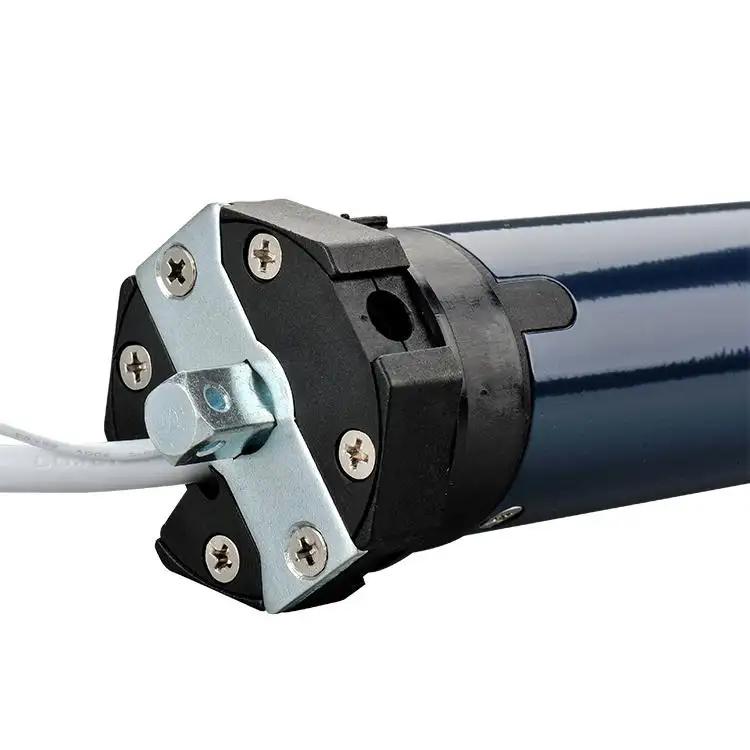
Close-up of a heavy-duty tubular motor assembly for commercial aluminum roller shutters, highlighting the mounting bracket and wiring
Many markets use nominal 230 V, 50 Hz supplies, while North American installations commonly use different electrical configurations. Nevertheless, actual site conditions should always be confirmed with the project electrician.
The purchase specification should identify:
- Supply voltage and frequency.
- Single-phase or three-phase power.
- Motor rating and permissible load.
- Control panel and limit-setting arrangement.
- Required operating controls and safety devices.
- Manual emergency operation, where needed.
- Compatibility with the site’s electrical and automation systems.
If the motor and control panel are ordered before these details are confirmed, the buyer may face additional costs for replacement equipment, wiring changes, or commissioning adjustments.
5.2 Consider Operating Frequency, Not Just Motor Power
A door used several times a day has different requirements from one serving a busy loading bay.
For high-cycle applications, the motor’s duty rating and thermal characteristics deserve particular attention. A motor that is suitable for occasional operation may not be appropriate for repeated operation throughout a long working shift.
Ask the supplier to specify the intended duty conditions and confirm that the selected motor is suitable for the expected operating schedule.
The curtain weight and drive arrangement should also be included in the calculation. Motor selection should not be based on the opening dimensions alone.
5.3 Safety Devices and Fire-System Integration
Depending on the application and applicable regulations, a commercial roller shutter may require photocells, safety edges, emergency controls, interlocks, or other protective devices.
For logistics facilities, the control system may also be integrated with radar sensors, vehicle detection, access control, or a building management system (BMS).
Fire and smoke-control requirements need separate consideration. A standard commercial roller shutter should not be assumed to be fire-rated or suitable for smoke extraction simply because it can be connected to an external control signal.
If the project requires fire protection or smoke-control functions, the door system, operating sequence, certification, and installation must be appropriate for that specific purpose and the applicable local requirements.
These requirements should be clarified during the design stage, not added as an afterthought during commissioning.
6. How to Compare Supplier Quotations Without Comparing the Wrong Products
When two quotations differ significantly in price, it is tempting to assume that one supplier is simply more competitive.
Sometimes that is true. In other cases, the quotations may cover different specifications.
One quotation may include a particular surface finish, reinforced guide rails, a specified motor duty rating, and safety accessories. Another may cover only a basic curtain and drive system, leaving important components or installation requirements outside the quoted price.
The totals are therefore not directly comparable until the scope has been checked.
6.1 Compare the Specification Line by Line
Before making a decision, establish whether both quotations cover the same:
- Curtain profile, material, and dimensions.
- Surface finish and color requirements.
- Guide rails, bottom bar, shaft, brackets, and fixing accessories.
- Motor type, electrical configuration, and duty rating.
- Control system and safety devices.
- Required wind-load or insulation performance.
- Technical drawings, documentation, and inspection requirements.
- Packaging, delivery terms, and supply scope.
Ask each supplier to identify exclusions and deviations from the project specification.
This is particularly important for international procurement, where installation, electrical work, and commissioning may be handled by different companies.
6.2 Clarify What the Supplier Is Actually Supplying
A quotation for a roller shutter curtain and motor is not necessarily a quotation for a complete installed door system.
The buyer should establish whether the supplier is providing the complete door assembly, only the main components, or a package that requires additional locally sourced items.
Responsibilities for structural supports, electrical connections, installation, testing, and commissioning should also be clear.
A lower initial price may still be the right choice if the scope genuinely matches the project. The objective is not to select the most expensive specification, but to avoid paying extra later for components or work that were never included in the original quotation.
7. International Shipping: Protect Long Components Before They Leave the Factory
Roller shutters contain long profiles and other components that can be vulnerable to bending, impact, scratches, and moisture during handling and transportation.
For export orders, packaging should be planned around the actual dimensions of the goods, the shipping method, container loading, and the handling conditions expected along the route.
7.1 Protect the Components That Are Most Vulnerable to Damage
Long guide rails, shafts, and finished aluminum profiles require particular attention because damage may affect both appearance and installation accuracy.
Depending on the shipment, suitable measures may include reinforced cartons or crates, internal supports, surface-protection materials, and moisture-resistant wrapping.
Packaging should also prevent smaller accessories from moving freely and damaging finished surfaces during transport.
Before shipment, buyers should confirm the packing method, package dimensions, gross weight, and loading arrangement. This information is useful for freight planning and for checking whether the goods can be handled safely at the destination.
7.2 Check Wood Packaging Requirements
Where wooden packaging is used in international trade, applicable import requirements must be followed. This may include ISPM 15 treatment and marking for regulated wood packaging materials.
A general statement that a crate has been fumigated is not, by itself, sufficient evidence that every destination requirement has been met.
Buyers should confirm the actual packaging method and applicable compliance markings before shipment, especially when the destination country has specific import procedures.
7.3 Inspect the Packing List Before Dispatch
A packing list should identify the packages, quantities, and relevant product or component descriptions clearly enough for the receiving team to check the shipment.
For projects involving multiple shutter sizes, labeling packages by door number or opening reference can make sorting and installation considerably easier.
This small administrative step can save time at the destination, particularly when several doors and accessory packages are delivered together.
8. The Real Cost of a Roller Shutter Is More Than Its Purchase Price
For commercial buyers, the relevant question is not always which supplier offers the lowest price. It is which suitable configuration delivers the best overall value for the intended application.
Total cost of ownership includes the purchase price, installation, maintenance, replacement parts, and the financial impact of downtime.
The relative importance of each cost depends on the building.
For a small retail shop, the initial purchase price and ease of maintenance may dominate the decision. For a busy logistics facility, an unexpected door failure may interrupt vehicle movements and delay warehouse operations. For a coastal property, corrosion protection and access to replacement hardware may be more important over time.
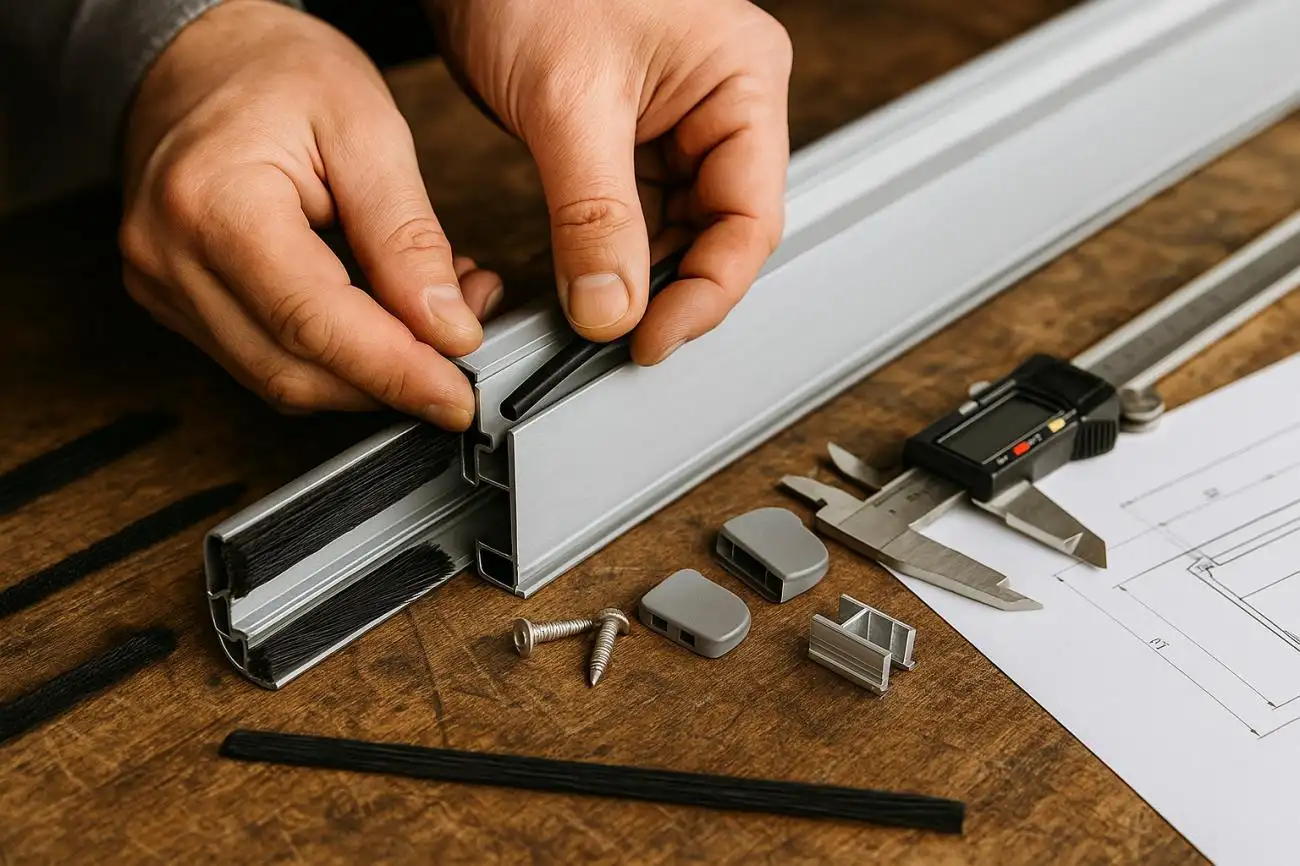
Hands inspecting an extruded aluminum roller shutter profile with weatherstripping, alongside a digital caliper, screws, and technical drawings for supplier quotation evaluation
A practical comparison should therefore consider:
| Cost Factor | What to Examine |
|---|---|
| Initial Purchase | Curtain, motor, controls, hardware, and finish. |
| Installation | Site preparation, fixing structure, electrical work, and commissioning. |
| Maintenance | Cleaning, inspection, adjustment, and routine servicing. |
| Replacement Parts | Availability and compatibility of motors, bearings, seals, and controls. |
| Operational Downtime | Potential disruption to retail, logistics, or production activities. |
| Service Life | Environmental exposure, component quality, and maintenance practices. |
| Thermal Performance | Potential heat-transfer implications where insulation is required. |
For example, paying more for a suitable coating system may be justified in a highly exposed coastal location. Similarly, selecting a motor designed for the required duty cycle may be more economical than choosing a cheaper unit that is unsuitable for frequent operation.
However, these decisions should be supported by the actual specifications and operating conditions. A higher-priced product is not automatically better, and an insulated shutter does not automatically guarantee a particular reduction in energy consumption.
The best purchasing decision is one that balances the required performance with realistic installation, maintenance, and operating costs.
9. Before Placing an Order: A Practical Buyer Checklist
Before approving the final quotation, make sure the supplier and project team have agreed on the following points.
Product and Dimensions
- Curtain type, profile specification, material, and finish.
- Opening width, height, headroom, and side room.
- Guide-rail arrangement and mounting method.
- Maximum permitted dimensions for the selected configuration.
Performance and Operation
- Required wind-load classification, where applicable.
- Insulation requirements, where relevant.
- Motor capacity, duty rating, and operating-temperature limits.
- Electrical supply and control requirements.
- Required safety devices and interfaces.
Procurement and Delivery
- Complete supply scope and exclusions.
- Approved technical drawings.
- Production lead time and inspection requirements.
- Packaging method and shipment dimensions.
- Required documentation and wood-packaging compliance, where applicable.
- Spare-parts availability and maintenance information.
Resolving these points before production is usually easier than correcting them after the goods have been manufactured or shipped.
PROJECT SUPPORT
Discuss Your Commercial Roller Shutter Requirements with Our Team
Selecting commercial aluminum roller shutters for Middle Eastern projects requires a clear understanding of the site, the intended use, and the technical requirements of the opening.
Coastal corrosion, fine sand, high operating temperatures, wind pressure, and frequent cycling do not all require the same solution. The right specification depends on which conditions apply to the project and how the shutter will be used.
If you are sourcing roller shutters for a retail development, warehouse, factory, or commercial building in Dubai, Abu Dhabi, Riyadh, Jeddah, or another international market, our team can help review your requirements and identify the product specifications that need to be confirmed.
You can contact us for:
- Product catalogs and technical datasheets.
- Curtain profile and installation drawings.
- Available specifications and surface-finish options.
- Motor and accessory configuration information.
- Export packaging details.
- Project-based quotations.

Secure export packaging of aluminum roller shutter hardware components in cartons stacked on wooden pallets with edge protectors and stretch wrap
To help us review your request, please include the project location, opening dimensions, required quantity, intended application, and any available drawings or technical specifications.
Product configurations and performance depend on the selected system and project requirements. Final specifications should be confirmed against the manufacturer’s technical documentation and applicable project standards.
Frequently Asked Questions
1. Is specifying aluminum material sufficient for coastal roller shutter projects?
No. Beyond the aluminum profiles, exposed hardware such as brackets, shafts, and fasteners is also vulnerable to high salt and humidity. You must ensure these components feature appropriate protective coatings or anti-galvanic corrosion designs to prevent accelerated deterioration.
2. How can we prevent guide rail wear in dusty and sandy environments?
Weatherstripping brushes alone cannot completely block fine sand. You must comprehensively evaluate the guide rail design, curtain operating clearance, and ensure the system allows accessible routine cleaning to prevent friction and mechanical wear.
3. Does motor selection for commercial shutters only depend on lifting capacity?
No. For high-cycle commercial doors, prioritizing the motor's duty cycle rating, rated torque, permissible operating temperature limits, and thermal protection features is just as critical as its baseline lifting capacity.
4. How should I choose between solid, perforated, and insulated roller shutter slats?
Solid slats maximize physical security and privacy; perforated slats provide ventilation and off-hours visibility for retail storefronts; insulated polyurethane-filled slats are essential for temperature-controlled warehouses to minimize HVAC heat transfer.
5. Does simply increasing the profile thickness guarantee high wind resistance?
Wind resistance depends on more than just slat thickness. It requires a complete structural assembly—including reinforced guide rails, heavy-duty bottom bars, and verified wall anchors—that collectively meets design standards such as EN 12424.
6. What are the most frequently overlooked dimensions when measuring an opening?
Headroom and side room are commonly neglected. Restricted space in these areas can directly prevent the successful installation of the roller tube, brackets, safety devices, or the external motor unit.
7. What electrical specifications must be verified for international projects?
You must confirm the destination's actual site voltage, supply frequency (e.g., 230V, 50Hz), phase, control panel interfaces, and verify the inclusion of a manual emergency override system in case of grid fluctuations.
8. Can standard commercial roller shutters be used for fire or smoke control?
No. If a project has strict fire protection or smoke exhaust requirements, the door system, material certifications, and control logic must be specifically designed, tested, and certified for fire safety compliance.
9. How should buyers evaluate significant price differences between supplier quotations?
Lower prices often exclude weather-resistant surface treatments (e.g., Qualicoat Class 2), safety photocells, or reinforced guide rails. Buyers must conduct a line-by-line comparison of the bill of materials and clarify installation boundaries.
10. What are the export packaging requirements for long roller shutter profiles?
Long aluminum profiles require rigid packaging to prevent bending and impact damage during sea freight. Additionally, all wooden crates or pallets used in international shipping must comply with destination quarantine standards, such as ISPM 15.